Posts

Nataraja: Exploring the Phisopical and Spiritual Significance of This Ancient Dance Statue

Image
It is undeniable that statues are made for a specific function or have particular criteria.  Most of the time, they are made to pay honor to a deity or a person. Otherwise, they serve as a cultural memorial that is supposed to last ages.  As a result, throughout history, the sculpture has portrayed many emotional or heavenly links related to humanity. Many statues, whether large or little decorative ones are so widespread that they have become a cornerstone in the overall art and architectural sectors.  The Nataraja statue is a prominent artifact that needs no introduction, as it is present in most Indian households. We’ll decode the features of the Nataraja Statue and try to understand why it holds such an important place in Indian society.   Symbolism  Nataraja is universally known as the "Lord of the Dance," this structure is depicted and revered as a potent emblem with many religious and cultural connotations.  Lord Shiva is depicted in a dynamic ...

Hanuman: Lord Rama Loyal and Loving Devotee

Image
It doesn’t need to be said that religion and spirituality connect the numerous threads of human existence. These superstructures and deities guide lights and moral compasses for human thoughts and beings. As such, a significant portion of human life revolves around them.  Throughout time and history, the divine and the spiritual have worked together to lead us, complementing and influencing individual and community evolution.  As a result, the role of specific deities becomes critical here. They become more than life, inculcating legends that last for generations and are the pivot for ideas, spirituality, and knowledge. Such is the case with Lord Rama and Hanuman. Who hasn’t heard of them and their overall importance?  Underneath, we’ll discuss all the features and significance that Hanuman and Lord Rama inculcate. Let’s start, shall we?   The Legend of Lord Rama and Hanuman  The credit for telling the story of Ram and Hanuman primarily goes to The Ramayana...

Introduction to Hindu Gods and Goddesses

Image
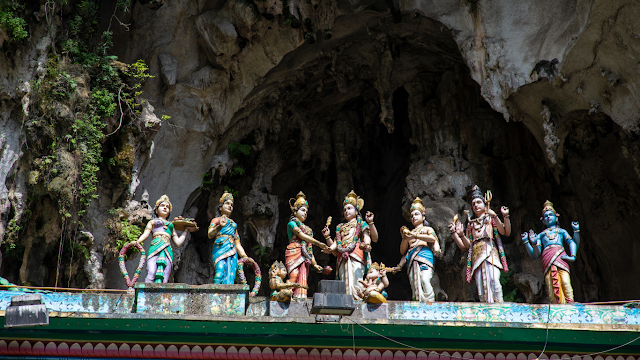
  Hinduism has a large number of gods with great powers. One of these, whom they regard as supreme, is the object of devotion for the majority of Hindus. The most important deities are depicted in art in a wide range of forms and settings taken from stories, and they all have complex personalities. Physical traits and objects they hold or wear that have symbolic meanings are frequently used to identify them. People frequently respond in a variety of ways when asked about their favourite Hindu deities, citing Ganesha, Shiva, Vishnu, Hanuman, Durga, and Lakshmi, among others. However, the same response is frequently given when asked about their relationship to other Hindu gods and goddesses. Hinduism, also known as Vaishnavism, Shaivism, or Shaktism, is primarily devoted to Vishnu, Shiva, or the Goddess. Due to a resurgence in Hindu devotional practice in the early first millennium, these customs developed over many years and gained popularity. In this blog post, we will briefly disc...

Significance of Lord Ganesha in Hinduism

Image
Ganpati, Vinayaka, Vighneshvara, Ekadanta, Lambodara, and Gajanana are some of Lord Ganesha's other names. In Hinduism, he is also known as the God of Beginnings. Because he guards writers, thinkers, and bankers, he is revered before major initiatives. Hindu texts describe the universe as a cosmic machine, with the Gods acting as its administrators. Hindus worship Ganesha, the obstacle-remover, prior to important life events like business, marriage, and childbirth. People from all over the world pray to him, and he breaks down obstacles to the soul's spiritual development. Ganesha is highly regarded because he is the god of astrology and the guardian of secret knowledge. He is revered by those who study Vedic science because they believe he is an expert on how planets affect karma and destiny. The mantra "om gam ganapataye namaha," which translates to "I bow down to Ganesha, the remover of obstacles," calls upon Ganesha's compassion. His birthday is cele...

Divine Shakti Durga and Interesting Story About Her

Image
Hinduism is the oldest religion in ancient times till date. It has its traces back to the 15th century in Indus Valley which is known as current Pakistan. Hinduism has no single founder yet defined by many beliefs and sects. Hinduism has many sects to be purposefully followed and maintained. These are Vaishnavism, Shaivism, Shaktism, and Smartism. Hinduism is set on the pillars of Trimurti of gods, Vedas, Upanishads, and epics. Here, the trinity of God refers to Brahma (the creator),  Vishnu (preserver), and Shiva (the destroyer). Apart from gods, goddesses are also an integral part of devotion and manifestation. These sects are actually groups of people who follow only one god of their own sect. In Vaishnavism, people follow and worship only Vishnu, the preserver of trinity. In Shaivism,  people follow and worship Shiva. In Smartism,  people do not follow any single god instead they believe in supreme being, oneness of gods and goddesses. They are Liberal and non sectari...

The Adventures of Charismatic Krishna as Goverdhan Girdhari

Image
Krishna is the eighth incarnation of Lord Vishnu. Krishna is the most loved, most followed and most popular god of Hinduism. Krishna was born to king Vasudev and Queen Devaki in the jails of Mathura. His biological parents were captivated by his maternal uncle Kansa. Kansa was afraid of his death by the eighth child of Yashoda, as was predicted. Krishna was shifted to the house of Nandbaba within a few minutes of his birth. They were his foster parents who brought him up with utmost love and care. Nand Baba and Yashoda witnessed all his mischievous and mesmerising Balleela. He killed many demons there. Let's put light on Goverdhan Girdhari ‘s chapter Girdhari means a person who holds (dhara) the hill(gir). Let's read more vividly. According to holy text, once, in Vraj region, people used to worship Indra(god of rain and king of heaven). Main livelihood of people was agriculture and cow farming. In those times, sunlight and rains were major source of irrigation. People used to w...